 EN
 English
 中文简体
 Français
 Español
 Latine
 عربى

Industry News
Compressed Foam Explained: Density, Recovery, Grades, and Real-World Uses
Content
- 1 Compressed Foam Means Two Very Different Things
- 2 From Full Block to Flat Pack: The Vacuum Compression Journey
- 3 The Specs That Decide Whether Compressed Foam Performs
- 4 Compression Set: The One Number That Predicts Regret
- 5 Common Compressed Foam Grades at a Glance
- 6 Matching Compressed Foam to the Job
- 7 Cutting, Expanding and Storing Compressed Foam
- 8 What Buyers Ask and What the Line Actually Shows
- 9 Frequently Asked Questions About Compressed Foam
Compressed foam is one of those terms that means something slightly different depending on who is asking. An importer means a sofa that arrives in a box the size of a wardrobe. A materials engineer means the thickness a sample loses after twenty-two hours clamped at 70 degrees Celsius. A packaging buyer means a closed-cell sheet that has been densified so it fits a thinner carton. All three descriptions are accurate, and mixing them up is expensive.
We have been foaming polyurethane since 1996, first by hand and now on automated lines in Zhejiang and Jiangxi, so we end up untangling this question most weeks. The distinction matters because it decides freight cost, return rates, and whether two suppliers are even comparing the same number on a datasheet.
This guide covers both meanings of compressed foam, the specifications that predict how a compressed block behaves after it is unpacked, and the practical choices for seating, bedding, pet products, footwear, and industrial parts.
Compressed Foam Means Two Very Different Things
The fastest way to avoid a costly misunderstanding is to separate the packing method from the material property. Almost every argument about compressed foam comes from blending those two ideas together.
Vacuum-compressed foam: a packing method
Nothing about the chemistry changes here. Air is drawn out of the open cells, the block flattens under atmospheric pressure, and the result is sealed in film. A modular sofa that occupies a little over one cubic metre when expanded can ship in roughly a third of that, depending on the grade, the cell structure, and how long it stays under vacuum. When the film is opened, the foam pulls air back in and returns to very close to its original thickness.
The trade-off is time and handling. You gain cube, you lose the ability to inspect the piece before it ships, and you accept an expansion window of a day or more on the receiving end. We went through the arithmetic in our breakdown of how shipping volume drops when a vacuum-compressed sofa bed is packed, which is worth reading if freight is your main concern.
Compression-set foam: a measured property
Here the foam is deliberately held compressed, usually at 50% or 90% of its original thickness, at elevated temperature for a fixed period, then released. The thickness that never comes back is expressed as a percentage, and that figure is the compression set. A 4% result is excellent. A 15% result means a seat cushion that visibly thins within a season.
The same idea appears on the production side as compression moulding, where foam is shaped and densified inside a closed tool to create contours, edge profiles, or firmer support zones. If a supplier quotes you a "compressed foam density" without saying which of these processes they mean, ask them to be specific before you compare prices.
From Full Block to Flat Pack: The Vacuum Compression Journey
Most vacuum compression happens in six stages. Skipping any one of them shows up later as a sofa that stays creased, or a mattress that never quite reaches its stated thickness.
- Foaming and curing. Polyurethane is metered, mixed, and poured to rise into a block. Our lines use German KRACHT foaming pumps with Siemens PLC control, which keeps raw material temperature and flow inside a tight window so cell structure stays consistent from block to block. Fresh blocks cure before anything else happens to them.
- Cutting and profiling. The cured block is cut to the finished dimensions of the part: seat cores, backrests, mattress layers, bolsters. Density and indentation hardness are checked here, not at the end of the line.
- Conditioning. Cut foam rests so it finishes settling. Foam that goes into a bag too soon fights the vacuum and recovers unevenly at the far end of the journey.
- Compression. The piece is rolled or folded and the air is drawn out. Volume typically falls to between a quarter and two fifths of expanded size, and the foam becomes rigid enough to protect itself in transit.
- Sealing. Film is sealed around the compressed bundle. A pinhole means the foam slowly re-expands inside the container, which is where a large share of "damaged in transit" claims actually originates.
- Recovery. After unpacking, the foam draws air back through its cell walls. Thin sheets open in minutes; a high-density mattress core can take two to three days, and longer in cold weather.
Lower temperatures slow recovery noticeably. A compressed sofa delivered in January to an unheated warehouse can look under-thickness for two or three days and then finish normally. That is not a defect, it is physics, and it is worth explaining to your customers before they open the box.
If you would rather see the end result of that process than read about it, the vacuum compressed sponge sofa range is where we apply it most often: modular, L-shaped, and U-shaped pieces that ship flat and build themselves back up on the customer's floor.
 Vacuum Sponge Compressed Sofa ManufacturersOur Company is China Vacuum Sponge Compressed Sofa Manufacturers and Vacuum Compressed Sofa Set Suppliers .For three decades, our expertise and dedication have been wo...View Product →
The Specs That Decide Whether Compressed Foam Performs
A datasheet can look impressive and still tell you almost nothing about how a cushion behaves in year three. These are the numbers that genuinely predict performance, along with the ranges we see most often in seating and bedding work.
| Specification | What it measures | Typical range | Why it matters |
|---|---|---|---|
| Density | Mass of foam per cubic metre | 18 to 45 kg/m3 for seating, 40 to 80 kg/m3 for mattresses | Heavier foam generally lasts longer, but density alone does not tell you how firm it feels |
| IFD / ILD at 25% | Force needed to compress a standard sample by a quarter of its thickness | 90 to 400 N | This is what people really mean when they say soft or firm |
| Support factor | Ratio of 65% indentation force to 25% indentation force | 1.8 to 2.6 | Above 2.0 the foam stiffens as it compresses, which is what gives seating its supportive feel |
| Ball rebound | Height a steel ball returns after being dropped onto the surface | 35 to 60% conventional, 55 to 70% high resilience | Measures bounce rather than firmness, and separates HR grades from ordinary ones |
| Compression set | Thickness lost after being held compressed at elevated temperature | 2 to 10% | The single best predictor of long-term sagging |
| Tensile strength | Force required to pull a sample apart | 80 to 200 kPa | Matters for handling, rolling, and surviving vacuum compression without tearing |
| Airflow | Rate at which air passes through the cell structure | Grade dependent | Affects breathability and how quickly a compressed block re-expands |
Density is the most quoted and least useful figure on its own. A 30 kg/m3 high-resilience foam can outperform a 35 kg/m3 conventional foam in both comfort and durability, because what matters is how the polymer network is built, not simply how much material sits in a cubic metre. Read density alongside support factor and compression set, and you will avoid most specification mistakes.
Compression Set: The One Number That Predicts Regret
Compression set testing holds a sample compressed at elevated temperature for a defined period, releases it, and measures how much thickness never returns. A cycle of twenty-two hours at 70 degrees Celsius is the usual reference. Lower is always better, and the differences between grades are large enough to change what your customer experiences two years later.
Why this matters for compressed foam specifically: any product that travels under vacuum has already spent days or weeks in a squeezed state. If its compression set is poor, those weeks in the container start eating into the recovery you were counting on. That is why we verify rebound, indentation hardness, and tensile strength on incoming production rather than trusting a certificate issued a year ago. A ball rebound tester, an indentation hardness tester, and a tensile tester sit in our internal test centre for exactly this reason, and every batch is checked against the export standard before it is packed.
Common Compressed Foam Grades at a Glance
Most compressed products are built from one of six families. Each behaves differently under vacuum, and each has a job it does better than the others.
Conventional polyurethane
The workhorse of the industry. Open cell, easy to cut, forgiving on price, available from very soft to firm. Excellent for general seating and packaging inserts, but watch compression set when density drops below about 20 kg/m3.
High resilience (HR)
Higher ball rebound, better support factor, longer service life. The default choice for sofas and mattress cores that will be compressed, shipped, and then expected to look new after unpacking.
Memory foam (viscoelastic)
Slow recovery, pressure relief, and noticeable temperature sensitivity. It compresses very well, but it expands slowly, so it needs a longer recovery window than an HR grade on the same route.
Rebond
Shredded foam bonded into blocks. Firm and dense, economical in large volumes, and widely used for carpet underlay and budget mattresses. It is heavy, so part of the freight saving disappears.
Polyethylene (closed cell)
Does not absorb water and holds its shape almost indefinitely. Once densified it stays that way, which makes it useful for protective packaging and structural layers rather than comfort.
EVA
Rubber-like and highly resilient, used in footwear, mats, and protective cases. It compresses cleanly and springs back quickly, which suits products where recovery speed matters more than softness.
Matching Compressed Foam to the Job
The application decides the grade, the density, and, critically, how much compression the foam can take without permanent loss. Here is how that plays out across the categories we build most often.
Sofas and modular seating
HR foam at 25 to 35 kg/m3 with an IFD between 130 and 200 N and a support factor above 2.0. Modular pieces compress most easily because seat cores and backs can be bagged separately.
Mattresses
Comfort layers in memory foam from 40 to 80 kg/m3, over HR base layers around 30 to 45 kg/m3. Recovery windows are long, so plan the last mile of delivery around them.
Pillows
Memory foam pillows compress beautifully and are a common air-freight product for that reason. Contour moulded shapes and shredded fills behave quite differently under vacuum.
Pet beds
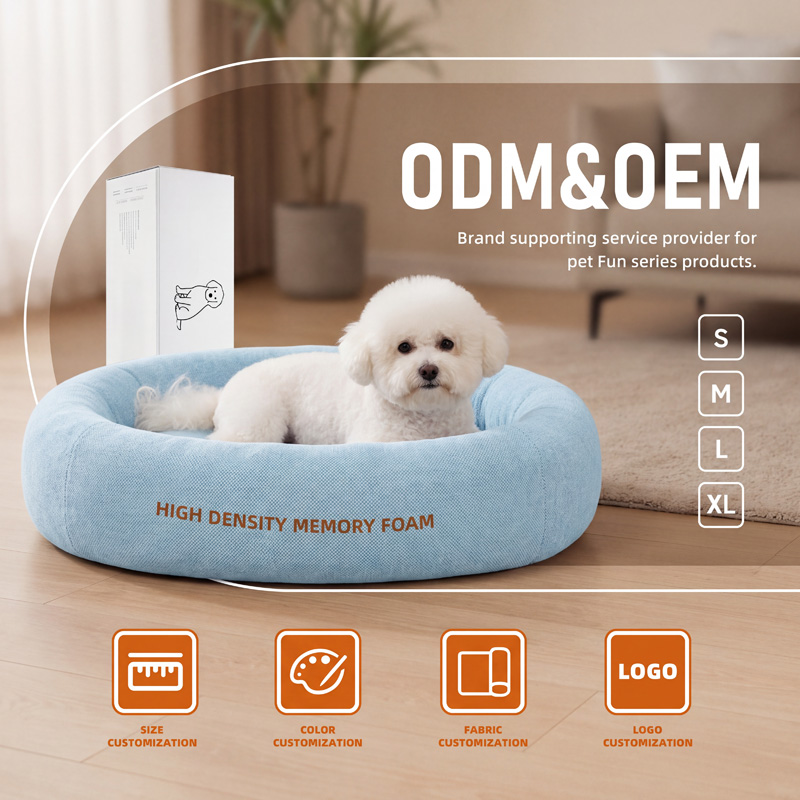
Bolsters and bases, often memory foam for winter products and HR for all-season ones. Compression helps enormously here, because pet beds are bulky and relatively low value per cubic metre.
Baby products
Pram and cot foam needs to be soft, safe, and low in emissions. Compression keeps import volumes sensible without changing the feel of the finished product.
Footwear
Harder, fatigue-resistant grades that hold up under repeated loading. Compressed for shipping, then expanded inside the shoe where the fit is judged.
Industrial and packaging
Protective layers, gaskets, and filtration parts. Closed-cell grades are preferred wherever water resistance and repeated compression are part of the requirement.
Mattress cores are where compression decisions carry the highest cost of error. A core that expands to 96% of its intended thickness is a warranty claim, not a rounding error, so recovery margin has to be specified into the grade from the start. Our sponge mattress range is built with that margin in mind.
 Custom Solid Memory Foam Sponge Mattress RangeLayered coil-free mattress with 45D support foam and slow-rebound memory foam, vacuum-compressed for shipping and customizable for OEM/ODM orders.View Product →
Cutting, Expanding and Storing Compressed Foam
These are the practical points that come up in almost every order conversation, and getting them right is usually the difference between a smooth launch and a batch of customer complaints.
Before cutting
Let the foam expand first. Cutting a still-compressed block gives you a part that grows after the knife has gone, and the dimensions will drift. If you must cut while compressed, allow 5 to 10% oversize and accept slightly less clean edges. Use a serrated blade or hot wire for memory foam, and a band knife for denser HR blocks.
While it expands
Give it time, warmth, and air. Around 20 to 24 degrees Celsius with reasonable airflow is ideal, and never stack heavy items on top of a recovering mattress core. Most thickness returns within the first twelve hours, while the final few percent can take another day or two.
Storing leftovers
Keep compressed stock in its original film, out of direct sunlight, and flat rather than folded. Foam held compressed for months takes noticeably longer to recover, so rotate stock oldest first. Heat and ultraviolet light do far more damage than compression itself.
What Buyers Ask and What the Line Actually Shows
Questions we hear
- Does vacuum compression damage the foam?
- How long before the customer can actually sit on it?
- Can memory foam be compressed the same way as HR foam?
- What compression ratio should we specify for a mattress core?
- Will the product still hold its warranty after weeks in a container?
What the data shows
Compression itself is gentle when it is short and the grade is right. Damage comes from time, temperature, weak film, and foam with a poor compression set to begin with.
- A sofa typically reaches usable firmness within a few hours and finishes recovering within one to two days.
- Memory foam needs a longer window than HR foam, and the same long container journey affects it more.
- Ratios beyond roughly 4:1 raise the risk of creasing on high-density blocks, so we design the part around the pack rather than forcing the pack onto the part.
- Every one of those answers is verified in-house before shipment. Our factory operates two production sites with an internal test centre, so recovery behaviour is measured rather than assumed.
Frequently Asked Questions About Compressed Foam
Does compressed foam stay compressed forever?
No, provided the film stays intact. Once the seal is opened, air flows back into the open cells and most of the thickness returns within one to three days. Closed-cell polyethylene is the exception: air cannot flow back in, so it stays densified more or less permanently.
How long does compressed foam take to expand fully?
Thin sheets open in minutes to a couple of hours. Upholstery cores typically take 24 to 48 hours. High-density memory foam mattress cores can take up to a week, and longer in a cold room, so build that into your delivery schedule.
Is compressed foam lower quality?
No. Compression is a shipping method, not a grade. Quality is set by the foam itself: density, indentation hardness, support factor, and compression set. A premium HR core that ships compressed is still a premium HR core when it arrives.
Can memory foam be vacuum compressed?
Yes, and it is done constantly. Memory foam recovers more slowly and reacts more to temperature than conventional foam, so specify a longer recovery window and avoid keeping it compressed for extended periods before shipping.
What is a good compression set value?
Under 5% is excellent for comfort foam. Between 5% and 10% is normal for general seating. Above 10%, expect visible thinning over the life of the product, particularly where the foam carries concentrated body weight every day.
Does compression change foam density?
No. Density is the mass of polymer per unit volume of material. Compression changes the volume temporarily, not the polymer content, so a block that expands back to its original size has exactly the same density it had before packing.
If you are sourcing memory foam for sleep products, pillows in particular, compressed packing is often what makes air freight viable in the first place. Our memory foam pillow range is built around exactly that route, with recovery behaviour tested before the carton is sealed.
Custom Slow-Rebound Memory Foam Pillow RangeHigh-density slow-rebound pillows with vacuum compression for air freight, plus custom shapes, covers, and OEM/ODM supply for bedding brands.View Product →Your email address will not be published. Required fields are marked *







Contact Information
-
 Zhejiang Base: No. 791 Zhangxin North Road, Xiaolin Industrial Park, Cixi City, Ningbo, China
-
Jiangxi Base: Chihu Industrial Park, Jiujiang County, Jiujiang City, Jiangxi Province, China
-
 +86-137-3611-4073
-
 1520942191@qq.com
Quick Link
Copyright © Cixi Tiansheng Sponge Products Co., Ltd. All Rights Reserved
OEM/ODM PU Foam Sponge Couch Manufacturers
