 EN
 English
 中文简体
 Français
 Español
 Latine
 عربى

Industry News
Vacuum-Packed Sofas: How Compression Works, What to Expect, and How to Choose
Content
- 1 What a Vacuum-Packed Sofa Actually Is
- 2 How the Compression Process Works, Step by Step
- 3 What Is Actually Inside the Foam
- 4 The Shipping Math: Why Volume Beats Weight
- 5 Choosing a Shape That Suits Your Room
- 6 Unboxing Day: What to Expect in the First 24 Hours
- 7 Living With It: Care, Cleaning and Longevity
- 8 Myths and Honest Trade-offs
- 8.1 Myth: it is just a mattress with armrests
- 8.2 Reality: frameless means less edge rigidity
- 8.3 Myth: compressed sofas are always cheaply made
- 8.4 Reality: cheap foam is easy to hide in a nice cover
- 8.5 Myth: it will never fully expand
- 8.6 Reality: expansion takes days, not minutes
- 8.7 Myth: it will never feel like a "real" sofa
- 8.8 Reality: it is excellent for access, average for grandeur
- 9 Why We Build Foam the Way We Do
- 10 Frequently Asked Questions
- 10.1 How long does a vacuum-packed sofa take to fully expand?
- 10.2 Is a vacuum-packed sofa less durable than a normal one?
- 10.3 Why does my new sofa feel firmer than expected?
- 10.4 Can I wash the cover of a compressed sofa?
- 10.5 Do I need tools to assemble it?
- 10.6 Will it fit through a narrow doorway?
- 10.7 Is compression suitable for every kind of sofa?
Ten years ago, getting a sofa into a fourth-floor walk-up was an event. You measured the door, measured the stairwell, measured the door again, and then watched two delivery drivers try to rotate a three-seater around a corner that physics had clearly designed against you. Vacuum-packed sofas exist because that moment is genuinely miserable, and because the furniture industry finally admitted that most of what you are paying to move around is air.
We have been making polyurethane foam since 1996, which means we have spent a very long time watching foam behave under pressure. Compression is not a marketing trick; it is a materials question. Get the foam chemistry right and a sofa can spend weeks inside a flat box and still recover into something you are happy to sit on for the next five years. Get it wrong and you end up with furniture that never quite loses the memory of its shipping crate.
This guide is the honest version. We will walk through what a vacuum-packed sofa actually is, how the process works from the foam batch to your living room, what the specification numbers really mean, where the trade-offs hide, and how to choose a shape that fits your room instead of the other way around.
What a Vacuum-Packed Sofa Actually Is
Strip away the packaging and a vacuum-packed sofa is a fairly ordinary piece of furniture. It has a foam body, a fabric cover, and in most modular designs no heavy internal frame at all. What makes it different is one extra step at the end of the production line: the finished unit is passed through rollers and sealed inside a plastic film while the air is drawn out. The foam collapses to a fraction of its natural thickness and stays that way until you cut the bag open.
The phrase gets used loosely, so it helps to know which version you are looking at. Some makers compress only the foam cores and ship the covers separately. Others compress complete modular sections, so the whole sofa arrives as a stack of flat parcels you assemble on the floor. A smaller number compress a fully assembled fixed sofa, which is the hardest version to get right because the arms and backrest have nowhere to fold.
The foam core
When you sit down, you are sitting on polyurethane foam. Density is measured in kilograms per cubic metre, and a seat base in the 30 to 40 kg/m³ range will hold its shape far longer than a 20 to 25 kg/m³ equivalent. Compression does not change that arithmetic.
The cover
Velvet, teddy fleece, linen-look polyester or a removable woven shell. The fabric has to stretch and recover along with the foam, so tightly tailored, low-stretch upholstery is a poor match for vacuum packing. Soft covers win here for practical reasons.
The seal
A film bag, a vacuum line and a heat seal. Some packs use small perforations or a slow-release valve so air can creep back in gradually; others rely on the seams and the foam's own open cells to let air return once the film is cut.
The practical consequence is simple: almost everything you care about, from softness to springiness to how the sofa looks in three years, is decided long before anyone switches on a vacuum pump. Compression is a logistics decision. Foam quality is an engineering decision, and it is the one worth your attention.
How the Compression Process Works, Step by Step
People often assume the foam is somehow manufactured flat. It is not. The sofa is built to its full size first, then flattened. Here is the sequence as it happens in a foam plant.
1. Formulating and curing the foam
Polyols, isocyanates and water are metered together and poured into a mould or a continuous block line. The water reacts to create the gas that forms the cells. The block then cures, often for a full day, before anyone measures it. Density, indentation hardness and ball rebound are recorded at this stage, because these are the values that will still matter after the sofa has travelled across an ocean.
2. Cutting and layering
Blocks are sliced and profile-cut into seat cores, backrests, arm pads and toppers. A good foam sofa is rarely one single block: it is usually a firmer support layer under a softer comfort layer, bonded with a foam-safe adhesive that will not stiffen over time.
3. Covering and finishing
The foam is fitted into its cover, zips and seams are closed, and any modular connectors, hook-and-loop strips or hidden clips are attached. Only at this point does the piece look like furniture rather than a foam shape.
4. Roller compression
The assembled unit is fed through a set of rollers that progressively squeeze the air out of the open cells. How far you can go depends on density and hardness. A soft 20 kg/m³ foam will compress beautifully and then disappoint you for years. A dense foam resists more, but it also recovers. Over-compress a fragile foam and the cell walls tear, which is how a sofa ends up permanently creased.
5. Vacuum sealing
Still under pressure, the unit slides into a film bag. The air is drawn out, the pressure differential holds the foam flat, and the bag is heat-sealed. From this moment the foam is effectively frozen in its compressed state, sometimes for months.
6. Boxing and loading
Flat parcels are stacked into cartons. Because the pack is now rectangular and rigid, containers can be loaded to a much higher fill rate, and warehouse space per unit drops dramatically. This is where the cost saving actually appears, long before it reaches your invoice.
7. Recovery at home
Once you cut the film, air re-enters through the seams and the open cell structure. Within the first hour a foam sofa typically reaches most of its final thickness. The last few percent takes longer, sometimes two or three days, and cold rooms slow the process considerably because foam stiffness is temperature dependent.
Notice that only steps four and five are really about vacuum packing. The other five steps are ordinary sofa manufacturing. That ratio is a fair summary of how much compression changes the product itself: less than most marketing suggests, and more than most skeptics assume.
What Is Actually Inside the Foam
If the shipping method is secondary, the foam specification is primary. Here are the pieces of the puzzle we look at when we assess any compressed sofa, including our own.
Density: the number that matters most
Density tells you how much material is packed into a cubic metre of foam, and it is the single best predictor of how long a seat will keep its shape. Budget sofas often sit around 20 to 25 kg/m³, which feels fine in a showroom and softens within a year of daily use. Mid-range furniture tends to run 28 to 35 kg/m³. Heavier-duty seating benefits from 35 to 45 kg/m³ or more. A vacuum-packed sofa is not automatically low density, but compression does make it easier for a manufacturer to hide a cheap foam inside a nice-looking cover, so ask for the figure.
Hardness is not density
A 35 kg/m³ foam can be soft and a 25 kg/m³ foam can feel firm. Hardness, usually measured as indentation force deflection, describes how the foam pushes back, not how long it lasts. Confusing the two is the most common mistake people make when comparing sofas online.
High-resilience foam
High-resilience foams spring back quickly and hold their shape well under repeated loading. In our own testing we look at ball rebound, where a steel ball is dropped onto a sample and the bounce height is measured. A livelier rebound generally means a seat that feels supportive rather than sluggish, and it is a good sign for long-term recovery after compression.
Memory foam layers
Memory foam is temperature sensitive and recovers slowly, which is exactly what you want in a pillow and sometimes what you want in a seat topper. In a compressed sofa it usually appears as a thin comfort layer over a firmer base. Expect it to feel noticeably harder in a cold room, and to soften within twenty minutes of contact.
Cover fabric
Stretch matters. A cover that cannot move with the foam during compression will pull seams apart on the way back. Soft plush fabrics, teddy fleece and stretch velvets survive the round trip better than crisp, heavily structured weaves.
Edge support, honestly
A frameless foam sofa has less rigid edge support than a timber-framed one. That is a real difference, not a marketing one: sitting right on the front corner of a foam-only seat will compress more than the same spot on a framed sofa. Higher-density base foam and a well-shaped seat cushion mitigate it, and many people never notice, but if you regularly perch on the arm of your sofa, this is worth knowing before you buy.
The Shipping Math: Why Volume Beats Weight
Freight is priced on volume far more often than on weight when it comes to furniture. A three-seat foam sofa weighs very little relative to the space it occupies, which is why the industry has spent so much effort flattening it. The numbers below are approximate, but the shape of the curve is consistent across almost every foam sofa we have measured.
Packed volume relative to a fully assembled sofa
The difference between an assembled sofa and a vacuum-packed modular one is roughly a threefold gain in container efficiency. That is the reason a compressed sofa can be shipped internationally and still land at a sensible price. We published a closer look at the mechanics of that saving, titled how compression cuts shipping volume, if you want the container-level detail.
| Packing method | Packed volume per seat | Units per 40ft container | Main trade-off |
|---|---|---|---|
| Fully assembled, no compression | About 0.33 m³ | Around 60 | Highest freight cost, needs two-person handling |
| Roll-packed, air still inside | About 0.20 m³ | Around 100 | Awkward cylindrical shapes, harder to stack |
| Vacuum-packed modular sections | About 0.10 m³ | Around 190 | Customer needs time and floor space to assemble |
| Vacuum-packed foam core only | About 0.07 m³ | Around 260 | Cover has to be fitted after delivery |
There is a second, quieter benefit. Flat, rigid cartons stack predictably. Damage rates in transit drop, because parcels are not shifting against each other in a container. Fewer damaged sofas means fewer returns, and that has as much effect on final cost as the freight saving itself.
Choosing a Shape That Suits Your Room
Once you have settled the foam question, the decision becomes mostly geometric. Compressed sofas come in a handful of recurring shapes, and each one solves a slightly different problem.
Modular U-shaped and cloud-style sectionals
These are the most flexible option and the easiest to compress, because every section is a separate parcel. A U-shaped arrangement wraps a conversation area and usually converts into a lounging surface when you push the pieces together. Because nothing is fixed, you can rearrange the whole thing on a rainy Sunday.
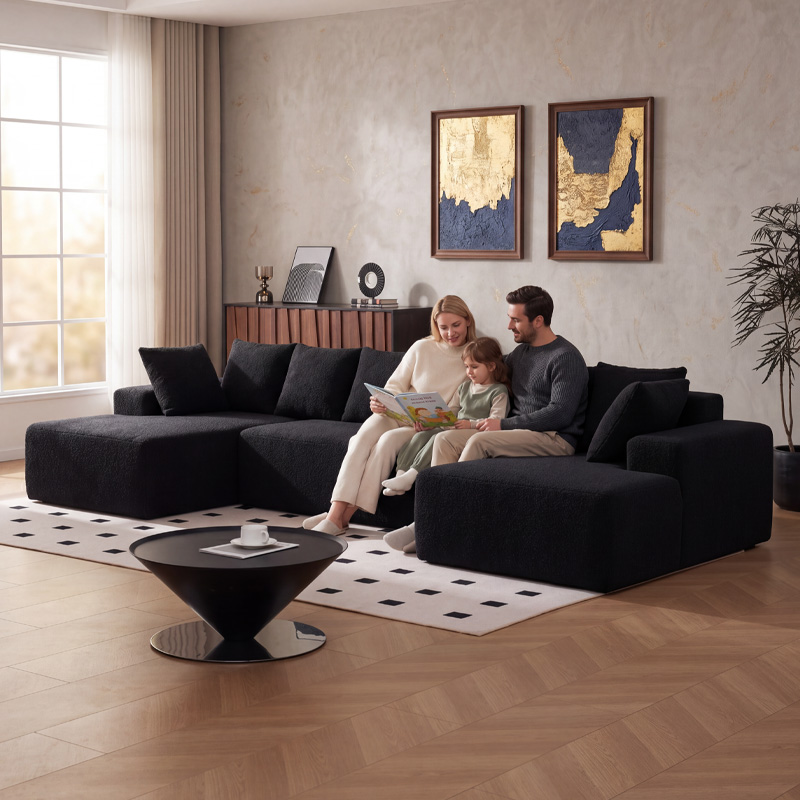 Modular U-Shaped Frameless Compression Sofa BedA vacuum-compressed modular sofa with U-shaped chaise modules that can transform into a large bed for flexible lounges.View Product →
Extra-wide chaise lounges
A wide, deep chaise is the shape to choose if you read, nap or watch films in the same spot every evening. Extra width matters more than extra length in practice, because it lets two people share the seat without negotiating elbow room.
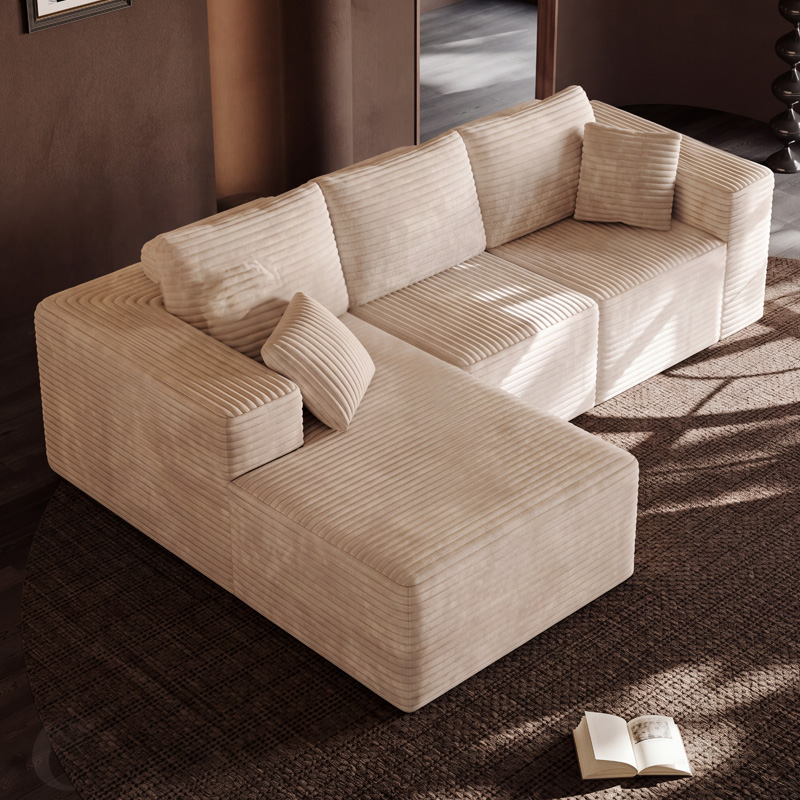
 46-Inch Extra-Wide Deep Chaise LoungeA vacuum-compressed sponge chaise with over 30-inch seat depth and matching throw pillows for reading, napping, or home theaters.View Product →
Compact three-seaters and space-saving designs
For studio flats, guest rooms and rental properties, a quick-assembly three-seater is often the sweet spot. It arrives flat, assembles without tools, and can be moved again when your lease ends without hiring a van.
 Quick-Assembly Three-Seater Space-Saving Compression SofaA vacuum-compressed, frameless three-seater that springs from its box and needs no tools, suited to rentals and bulk projects.View Product →
L-shaped modular layouts
An L-shape is the classic compromise between a sectional and a conventional sofa. It fits into a corner, leaves the middle of the room open, and compresses into two or three manageable parcels. If your room is longer than it is wide, this is usually the most efficient use of floor space.
A word of caution on dimensions: measure the lift, the stairwell and the turn at the top of the stairs, not just the doorway. Compressed sofas solve most access problems, but a fully expanded sectional still has to live somewhere, and an L-shape placed badly can make a room feel smaller rather than larger.
Unboxing Day: What to Expect in the First 24 Hours
The first hour
- Move the box into the room where the sofa will live before opening it. Empty boxes are heavy and awkward once the foam starts expanding.
- Slide the compressed unit onto the floor and cut the film along the length, not across the middle. Cutting across the middle makes the pack unfold unevenly.
- Stand back. You will hear air moving through the foam for a few minutes, which is normal.
- Leave the pieces flat for at least an hour before you try to assemble anything. Handling half-expanded foam distorts the shape.
The first day
- Assemble the modules once they have recovered most of their thickness, usually within two to four hours.
- Help the corners by patting and smoothing the foam with your palms. This is not superstition; it eases the cell walls back into position.
- Sit on it once in the afternoon. Light, even loading actually helps recovery.
- Wait a full 72 hours before judging firmness. Foam that feels slightly hard on day one usually softens noticeably by day three.
Cold weather is the one thing that reliably slows this down. If your delivery arrives in January and the box has been sitting on a cold doorstep, give the foam a full day at room temperature before you make any decisions about whether the seat feels right. Foam hardness is temperature dependent, and a cold sofa always feels firmer than a warm one.
Living With It: Care, Cleaning and Longevity
A foam sofa rewards fairly modest maintenance. The questions we hear most often tend to fall into two groups.
Practical care
- Rotate and swap seat cushions every few months so wear is distributed rather than concentrated in one spot.
- Vacuum the cover with a brush attachment instead of scrubbing it, which pushes debris deeper into the weave.
- Check whether your cover is removable. If it is, follow the label; most plush covers prefer a cool, gentle cycle and air drying.
- Keep the sofa out of direct sunlight where possible. Foam itself is not the vulnerable part here; the cover fabric is.
Longevity questions
- Will it sag? Not if the base foam is dense enough. Sagging is usually the foam losing height under load, which is a density problem, not a compression problem.
- Can I re-compress it? In principle yes, with a vacuum bag and some patience, but household vacuum bags rarely pull enough pressure to match a factory pack.
- Should I keep the box? Only if you plan to move within a year. Otherwise it is just a large object you will have to store.
- Does compression shorten the lifespan? Not measurably, provided the foam was not over-compressed in the first place.
Myths and Honest Trade-offs
Compressed sofas attract strong opinions, some of them well founded and some of them inherited from a decade ago when the category was genuinely rough. Here is our reading of the common claims.
Myth: it is just a mattress with armrests
The comparison is memorable but imprecise. A mattress is designed for even, distributed body weight. A sofa has to handle concentrated loads on a seat edge, a backrest and an armrest. The foam grades and layering are different, and so is the testing.
Reality: frameless means less edge rigidity
There is no timber frame to resist pressure on the outer edge, so a foam-only sofa will give more when you sit on the very front corner. Denser base foam reduces this, but it does not eliminate it.
Myth: compressed sofas are always cheaply made
Compression is a shipping format, not a quality grade. Low-density foam is cheaper to compress, which is why the two often travel together, but the format itself does not force the compromise.
Reality: cheap foam is easy to hide in a nice cover
Because you cannot sit on the sofa before it expands, the specification sheet matters more than it would in a showroom. Ask for density, hardness and rebound figures rather than relying on marketing language.
Myth: it will never fully expand
In the overwhelming majority of cases it does, given time and room temperature. Problems usually trace back to over-compression during packing or to a cold, damp room slowing recovery.
Reality: expansion takes days, not minutes
Video clips of sofas springing open in thirty seconds are edited. Expect most of the recovery in the first few hours and the final shape over two to three days.
Myth: it will never feel like a "real" sofa
A well-built compressed sofa feels like the foam it is made from. If it feels hollow or unstable, that is a specification problem rather than an inherent property of compressed furniture.
Reality: it is excellent for access, average for grandeur
Compression solves stairwells, narrow corridors, lifts and small doorways better than almost any other approach. It does not turn a foam sofa into a heavy framed chesterfield, and it is not trying to.
Why We Build Foam the Way We Do
We started as a hand-poured foaming workshop and grew into a manufacturer with two production bases in Zhejiang and Jiangxi, where automated dosing, temperature control and metering keep each batch consistent. That consistency is the whole point. A compressed sofa is only as good as the foam block that went into it, and foam that varies from batch to batch makes the compression step unpredictable.
Our test centre measures the things that matter after shipping: density, indentation hardness, ball rebound and tensile strength. Those four numbers tell you far more about a finished sofa than any photograph of it in a styled living room. You can read more about how our production lines are set up on our two production bases in Zhejiang and Jiangxi page, if that level of detail is useful to you.
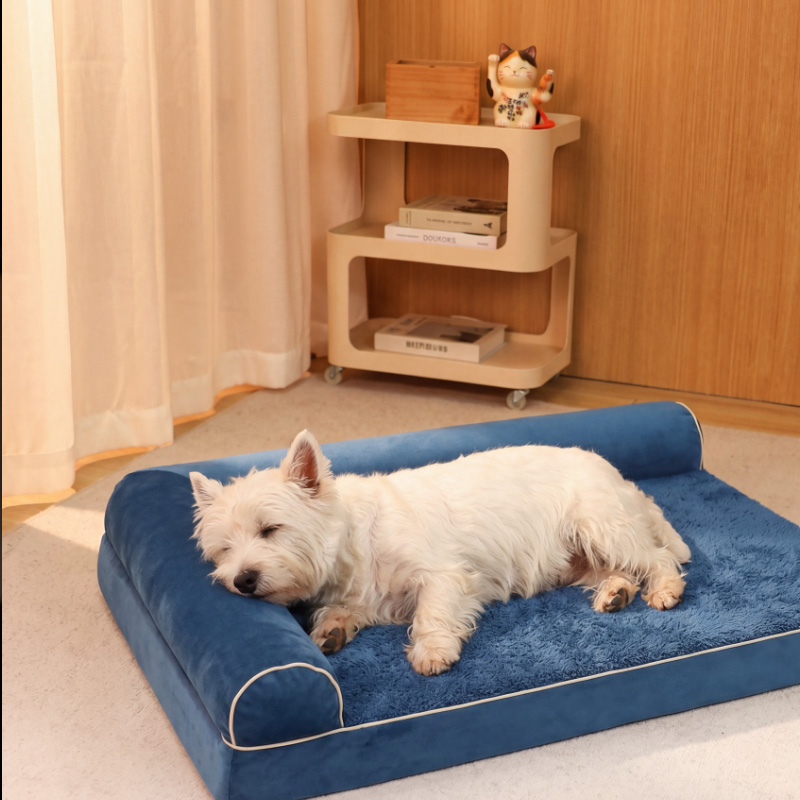
We also make sponge pet beds, memory foam pillows and sponge mattresses on the same principle, because the questions are identical: what density, what resilience, how will it hold up after a year of daily use. Compression simply adds one more variable to the list, and it is a variable we can control.
Frequently Asked Questions
How long does a vacuum-packed sofa take to fully expand?
Most of the recovery happens in the first two to four hours after you cut the film. The last few percent, especially at the corners and along the seams, usually takes between 24 and 72 hours. Warm rooms speed this up and cold rooms slow it down considerably.
Is a vacuum-packed sofa less durable than a normal one?
Durability is governed by foam density and resilience, not by how the sofa was shipped. A 35 kg/m³ high-resilience foam that has been compressed once will outlast a 22 kg/m³ foam that has never been compressed at all. Ask for the specification rather than judging the format.
Why does my new sofa feel firmer than expected?
Two reasons. Foam that has just expanded is still settling, and foam hardness changes with temperature. Give it three days at normal room temperature before you decide. If it still feels too firm after that, a softer comfort topper is a simpler fix than returning the whole sofa.
Can I wash the cover of a compressed sofa?
It depends on the design. Removable covers are common on modular models and usually tolerate a cool, gentle machine cycle, but always check the care label first. Fixed covers should be vacuumed with a brush attachment and spot-cleaned rather than soaked.
Do I need tools to assemble it?
Most modular compressed sofas need no tools at all. Sections usually connect with hook-and-loop strips, hidden clips or simple interlocking shapes. Where a frame is included, it tends to be a knock-down design with hand-tightened fittings.
Will it fit through a narrow doorway?
Almost certainly, and this is the strongest argument for the format. A compressed sofa arrives as flat parcels that one person can carry, so narrow stairwells, small lifts and tight hallway turns stop being obstacles. Check the parcel dimensions against your tightest opening before ordering, just to be safe.
Is compression suitable for every kind of sofa?
No. Heavy timber-framed sofas, tightly tailored upholstery and rigid spring units do not compress well. The format works best with foam-based, modular or frameless designs, and with covers that have enough stretch to survive the round trip.
Vacuum-packed sofas are neither a miracle nor a compromise. They are ordinary foam furniture with one extra manufacturing step, and that step solves a genuinely annoying problem: how to get a comfortable seat into a space that was never designed to receive one. If you buy on foam specification rather than on packaging photographs, give the sofa three days to settle, and choose a shape that suits the room you actually have, the format will rarely let you down.
If you are weighing up options for a project, a rental property or a small apartment, the useful questions are always the same ones: what density, what resilience, what happens after a year. Answer those and the rest is geometry.
Your email address will not be published. Required fields are marked *
-
-
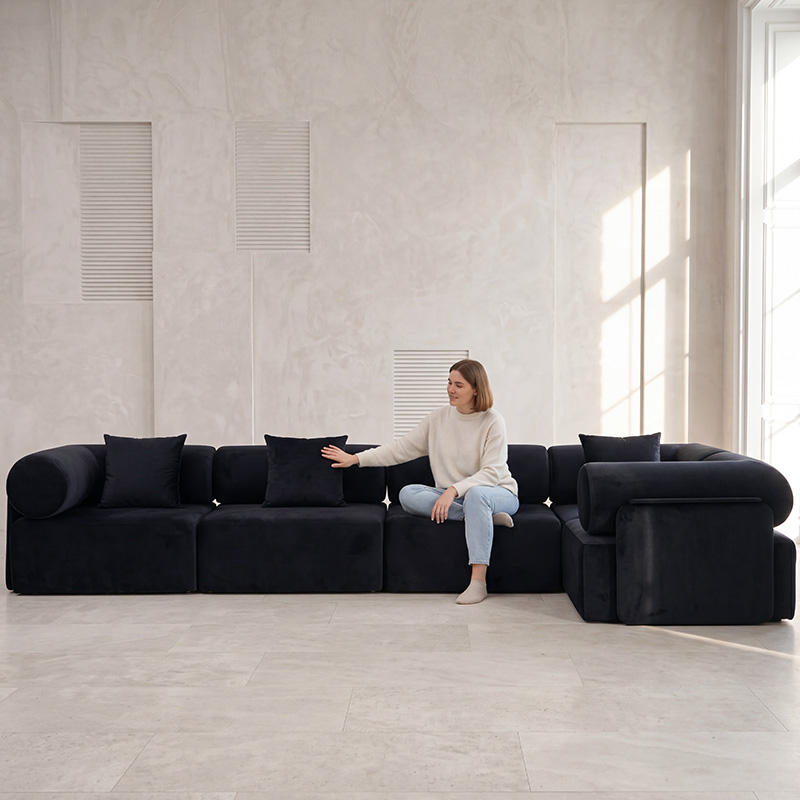
Vacuum-Compressed Sponge Sofa Cloud-like Modular U-shaped Multifunctional Light Luxury Frameless Compression Sofa Bed View More
-

Contact Information
-
 Zhejiang Base: No. 791 Zhangxin North Road, Xiaolin Industrial Park, Cixi City, Ningbo, China
-
Jiangxi Base: Chihu Industrial Park, Jiujiang County, Jiujiang City, Jiangxi Province, China
-
 +86-137-3611-4073
-
 1520942191@qq.com
Quick Link
Copyright © Cixi Tiansheng Sponge Products Co., Ltd. All Rights Reserved
OEM/ODM PU Foam Sponge Couch Manufacturers
